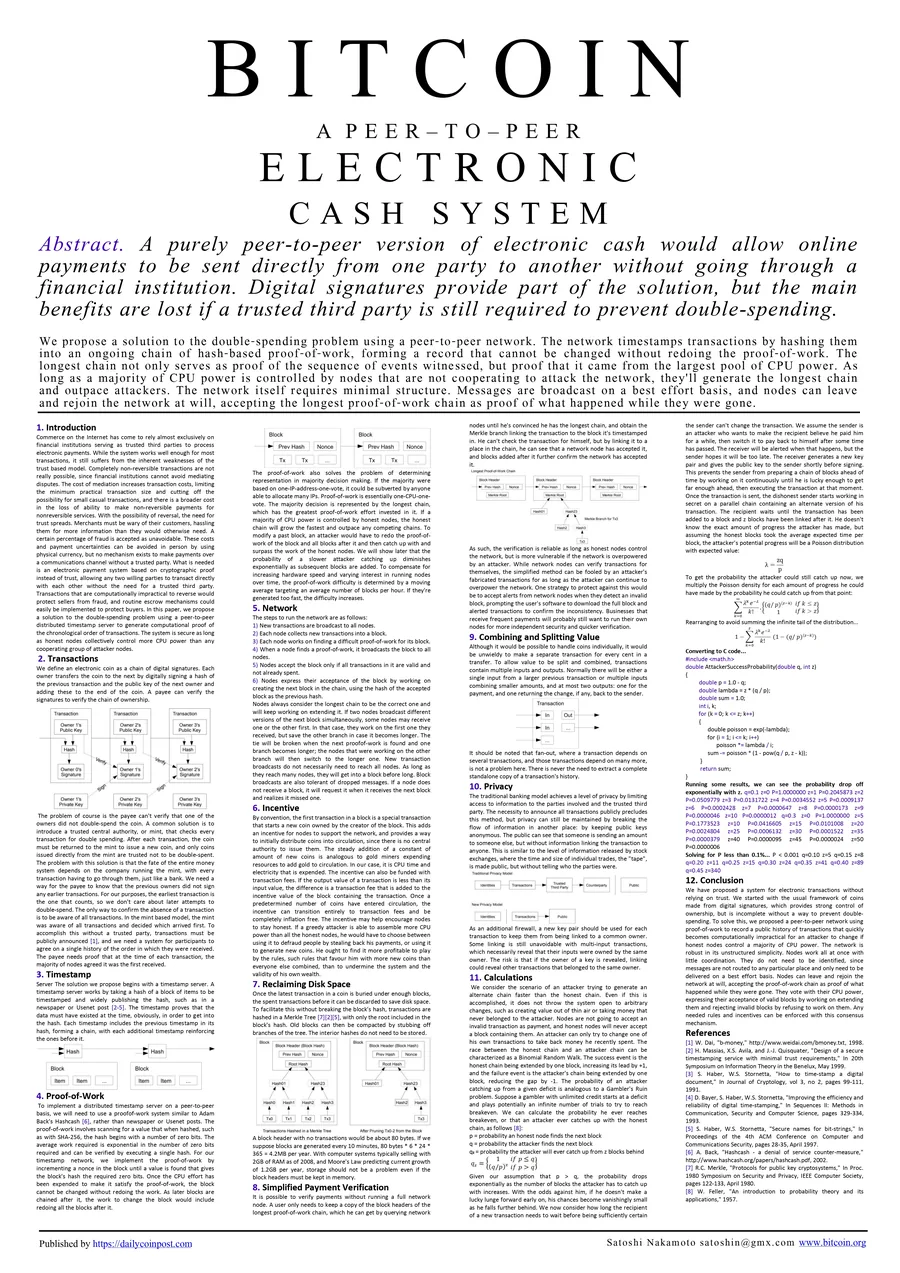
Bitcoin is a peer-to-peer electronic cash system whose participants maintain a shared transaction history without a central issuer. Satoshi Nakamoto circulated its design paper in October 2008; the network began in January 2009. Genesis block
This desk follows its technical ancestry, the network and software, and the application protocols that later interpreted its records in new ways.
Scope
The Bitcoin desk covers protocol history, implementations, mining, transaction structure, scripting, peer-to-peer networking, wallets, cultural history, standards processes and the technical ideas that later systems inherit or reinterpret.
Relationship to the other desks
- Ordinals reads additional structure into Bitcoin transactions and satoshis without changing Bitcoin consensus rules.
- Bitmap derives persistent place-like identifiers from Bitcoin block heights.
- The Metaverse desk intersects Bitcoin only where virtual-world history, ownership systems or persistent digital objects touch it. It is not subordinate to Bitcoin.
Before Bitcoin
Digital time-stamping follows the cryptographic history of linked time-stamp certificates and hash-tree aggregation through the 1990–1993 work cited by Bitcoin's white paper. Merkle tree traces the earlier 1979 authentication-tree invention and the distinct rules governing Bitcoin's transaction commitments. A service proving that documents existed before a published commitment is not automatically a permissionless network choosing a transaction history by accumulated work.
Hashcash supplies one of Bitcoin's directly cited technical ancestors: computational work that is expensive to produce but cheap to verify. The archive keeps the distinction sharp. Hashcash began as computational postage for email and remailers; Bitcoin attached proof-of-work to a shared chain of timestamped transaction history, network decision-making and coin issuance.
In August 2004, Hal Finney put another branch of the proof-of-work story into running code. RPOW accepted one-use Hashcash proofs and issued RSA-signed replacement tokens whose represented work could move through successive exchanges. Its double-spend defence still depended on an attested server and a database of seen tokens, making it a useful contrast with Bitcoin's later public replicated history.
Bit gold opens a neighboring branch. Nick Szabo later dated his conception of the idea to 1998, but the archive keeps that retrospective claim separate from contemporary records: Finney publicly named “Nick Szabo's concept of bit gold” in August 2004, and Szabo's detailed public specification survives from December 2005. The design chained proof-of-work objects through timestamping and a distributed property-title registry, while explicitly confronting the fact that proof objects produced in different hardware eras would not be naturally fungible.
The August 2008 Nakamoto–Back correspondence also exposes a useful piece of citation chronology. Hashcash was already present in Satoshi's draft when he contacted Adam Back; Back then pointed him to b-money, which Satoshi said he had not previously known. Hashcash preserves that chain and its evidentiary limits.
Electronic cash and Internet payments
The term electronic cash already covered quite different designs when Nakamoto used it in the 2008 title. DigiCash applied David Chaum's blind-signature research to privately spendable, bank-issued notes; the issuer still controlled redemption and double-spend checks. Mondex put issuer-backed value on smart cards that could pass money purse-to-purse without contacting a bank for each transfer. NetCash proposed exchanging coins among independent currency servers, with NetCheque supplying named-account clearing. These were different answers to privacy, transfer and settlement, rather than variants of one Bitcoin design. Chaum, 1985 · BIS, 2001 · Medvinsky and Neuman, 1993
The early Web produced another cluster of payment experiments. First Virtual requested confirmation from buyers by email; NetBill used an encrypted delivery and a payment-server receipt containing the key. CyberCash connected encrypted card authorisations to banks, later offering its separate CyberCoin wallet service. Millicent let vendors validate their own scrip, PayWord amortised repeated purchases through a hash chain, and MicroMint proposed coins formed from hard-to-produce hash collisions. Their primary records reveal genuinely different mechanisms for making low-priced commerce workable, not an established shared line of technical descent into Bitcoin. First Virtual, 1995 · NetBill, 1995 · Millicent, 1995 · PayWord and MicroMint, 1996
e-gold adds an actual, long-running account-money service to this picture. Beginning in 1996, it let users transfer precious-metal-denominated balances on a company's central ledger, with third-party exchangers bridging national currencies. Its operator retained the account history and depended on custody and legal institutions, a different model from both blind-signed cash and Bitcoin consensus. The 2008 guilty pleas and later asset-return proceedings also caution against treating online transfer finality as independence from an operator or the courts. Founder interview, 2020, retrospective · DOJ, 2008 · DOJ, 2014
WebMoney offers a Russian contemporary alongside these histories. A December 1998 interview recorded the public launch of WebMoney Exchange, its wallet software and its operator's reserve claims, while pressing unanswered questions about cryptographic anonymity and independent auditing. WebMoney later added different account instruments, including Bitcoin-denominated WMX units; conversion into an administered purse is not the same thing as a Bitcoin on-chain transfer. The 2022 interruption of its Russian ruble purse products following a bank-licence withdrawal shows how jurisdiction-specific payment instruments can fail without the underlying Bitcoin network failing. ''Computerra'', 15 December 1998, contemporary interview · WebMoney WMX documentation · WebMoney, 25 February 2022
PayPal brings the commercially scaled email-payment network into the same chronology. Confinity demonstrated a Palm Pilot payment application in July 1999, but its contemporary description still required later online processing. The company dated the launch of its email-payment product to October 1999; by 2001 it reported $3.5 billion of payments through accounts connected to bank and card networks. This was substantial user-facing payment circulation with a centrally operated ledger, risk checks and chargebacks, not a consensus system maintained by its users. ''Wired'', 27 July 1999, contemporary report · PayPal, 2001 Form 10-K
Liberty Reserve followed another centrally administered payment path, growing out of operators who previously ran an e-gold exchanger. Its proprietary balances moved across private accounts through third-party cash-in/cash-out services. A later criminal case documents its scale, but the reported $8 billion in gross transfers and the founder's admitted $250 million–$550 million in U.S.-linked criminal proceeds are not interchangeable measures. The 2016 withdrawal of a 2013 regulatory finding reflected the service's earlier shutdown, not exoneration. DOJ sentencing, 2016 · FinCEN withdrawal, 2016
The historical distinctions are important: a published proposal is not a live service; a deployed payment service is not proof of broad adoption; local or institution-to-institution verification is not Bitcoin's public transaction-history consensus. How to Make a Mint surveys the bank-issued digital-cash problem from a contemporary 1996 research perspective.
First recorded ordinary spend
Block 170 contains the earliest identified non-coinbase transaction in the canonical chain: an output originally created by the block-9 coinbase was spent into 10 BTC and 40 BTC outputs. The block-header timestamp is 12 January 2009. In his 2013 account, Hal Finney said Satoshi Nakamoto had sent him ten coins as a test; a contemporary payment acknowledgement survives in correspondence published in 2014, but it does not name a transaction ID. The chain proves the spend, not the identities behind the keys. First Bitcoin transaction documents the distinction and the source history. Block 170 · Bitcoin Wiki, decoded transaction example · Finney's later account
Finding other nodes
Early Bitcoin nodes used IRC nicknames to advertise candidate peer addresses. The client later introduced fixed fallback addresses and DNS seeds, turned IRC off by default on mainnet, and removed IRC support in version 0.8.2. Bitcoin peer discovery reconstructs the progression from versioned source and release notes. Discovery never delegated consensus authority to the IRC or DNS operator.
Wallets and recoverable keys
Early Bitcoin wallet backups became unreliable as newly generated keys outgrew old backup files. A July 2010 discussion proposed pre-generating reserve keys; source revision 163 implemented the Bitcoin key pool on 9 October, before the 21 October 0.3.14 announcement. The August 2010 Stone Man case exposes why newly generated change keys mattered. Later deterministic wallets derived future keys from a recoverable seed; their history includes the September 2010 IRC discussion, Gregory Maxwell's 2011 proposal, Electrum and BIPs 32/39. This is wallet history, separate from Bitcoin consensus. October source milestone · Contemporary loss report
Payment addresses and output scripts
Bitcoin address traces a wallet-facing convention back to the first client, where Base58 comments called payment strings “account numbers” even while mined and change outputs could pay directly to public keys. The tagged 2009 wallet's send-to-address path actually constructed P2PKH outputs, while its mining and change paths used P2PK; the two types were contemporary, not successive inventions. Original address-send code · Original change output The chain records outputs and locking scripts, not balances assigned to address strings. Later P2SH, Bech32 and Bech32m formats changed how destinations could be communicated; their specifications and adoption histories are separate questions. P2SH also changed consensus validation for spends of hash-committed scripts from April 2012, so the address's introduction and enforcement are distinct events. This distinction matters when an explorer or Ordinals indexer displays ownership by address. Original implementation · BIP 13 · BIP 350
Technical ancestry
Satoshi serial numbering traces 2012 proposals for assigning persistent identities to individual sats, including jl2012's order-preserving inheritance rule and casascius's suggestion to number the full subsidy sequence from zero. Colored coins records the neighboring asset-labeling lineage, including order-based coloring and the contemporary October 2012 discussion that explicitly compared the two approaches. The archive keeps both antecedents distinct from the later Ordinal theory implementation.
Witness and script upgrades
Segregated Witness reorganized transaction validation data into a witness structure, introduced block weight and versioned witness programs, and anchored witness commitments through the coinbase. Its reserved witness-version design later provided the upgrade surface used by Taproot. BIP 141
Taproot activated at block 709,632 on 14 November 2021, deploying Bitcoin's version-1 SegWit output together with BIP 340 Schnorr signatures and BIP 342 Tapscript. For Ordinals, the dependencies are specific: SegWit supplies witness data and weight accounting, Taproot supplies the script-path commitment and reveal mechanism, Tapscript changes the script resource limits, and Ordinals inscriptions add their own envelope and sat-level interpretation. BIP 341 · BIP 342
Routed payments and Lightning
Transaction replacement supplies an earlier technical boundary for off-chain payment history. The Bitcoin 0.1.5 source permitted higher-sequence versions of an unconfirmed transaction; a 19 August 2010 source commit disabled that mempool acceptance rule. Fee-based replacement returned in Bitcoin Core 0.12.0 in February 2016, initially requiring BIP 125 signalling, and became the Bitcoin Core default without signalling in version 28.0 (2024). These were relay and transaction-selection policies, not changes to the rule against confirmed double spends. 2010 source commit · Core 0.12 release · Core 28 release
Bitcoin payment channels were being proposed and implemented before Lightning. Akselrod's Bitcoin Wiki draft began in February 2013 and his March forum announcement outlined a proposed routed network of chained channels. Corallo's June 2013 bitcoinj commit established a separate, unidirectional client/server implementation; the August chained-channel prototype was expressly experimental and depended on a modified Bitcoin test node. These records separate design proposals from software and public-network adoption. Akselrod draft history · bitcoinj commit · Prototype README
Lightning Network belongs to a different layer from Bitcoin's application-defined asset protocols. Its payment channels use Bitcoin outputs for funding and enforceable exits while participants update balances and route conditional payments off-chain. The first dated Poon–Dryja presentation is from February 2015; relative-timelock activation in 2016 and SegWit in 2017 supported subsequent implementation work, while the first lnd mainnet beta was announced in March 2018. The archive keeps those different milestones apart, and distinguishes Lightning payments from the separately indexed asset ownership seen in Counterparty and Ordinals. Poon and Dryja, 23 February 2015 presentation · Bitcoin Core, 21 June 2016 · Lightning Labs, 15 March 2018
Application-layer assets
Colored coins is one of the archive's earliest examples of Bitcoin carrying application meaning that Bitcoin consensus itself does not evaluate. Two early implementation branches make the diversity inside that label visible. Open Assets Protocol evolved toward an OP_RETURN marker with explicit asset quantities, while EPOBC encoded its genesis/transfer tag and variable padding in nSequence and propagated color through ordered value segments. They share the colored-coin idea without sharing one wire format.
Mastercoin opened a different branch. Its 2013 launch treated selected Bitcoin transactions as messages in a second deterministic state machine for balances, currencies and exchange activity rather than as color propagation through particular Bitcoin outputs. The protocol was later renamed Omni Protocol, and Mastercoin's feature-heavy architecture became part of the immediate design environment from which Ethereum emerged. Project specification · Buterin retrospective
Counterparty supplies a neighboring but materially different branch. Launched publicly on 2 January 2014, it embeds protocol messages in Bitcoin transactions and has Counterparty-aware nodes reconstruct a separate deterministic ledger for assets and other state. Its tokens are not simply colored BTC outputs. The launch record is unusually revealing: a proposed miner-fee proof-of-burn mechanism was challenged in the announcement thread and changed toward an unspendable-address design within hours. Contemporary launch record · Current protocol documentation
The same 2013–2014 design space also opens one route toward Ethereum. Ethereum did not simply continue Colored Coins, Mastercoin or Counterparty; its proposal generalized beyond Bitcoin overlays into a blockchain whose consensus evaluates programmable application state. Keeping these branches visible helps the archive distinguish “interpret more meaning from Bitcoin” from “move the application logic into a new consensus system.”
Consensus edge cases
BIP 30 records Bitcoin's historical duplicate-transaction-ID problem: early coinbases could repeat byte-for-byte, and the reference client treated the repeated txid as an overwrite. The 2012 soft fork protected live UTXO state, while two already-mined duplicate pairs remain grandfathered into the chain. The same scar resurfaces in Ordinal theory, which must define what happens to serially tracked sats when Bitcoin's older UTXO entry is displaced.
Positional transaction references
BIP 136 proposed a concise Bech32-encoded way to name a confirmed transaction by block height and transaction index, optionally including an output. Its 2017 draft predates Bitmap and Ordinals; its location-based reference is not a transaction hash or a consensus identity, and the archive does not infer a direct lineage between these designs. BIP 136 — primary record
Block construction
Bitcoin transaction fees follows the difference between transaction input and output values from the 2009 client through free-transaction allowances, fee estimation and modern package policy. A fee is miner-claimable value, not a field in the transaction; minimum relay fees and wallet estimates are software policy rather than Bitcoin consensus. The block-170 payment paid zero fee. Original fee accounting · Later package-fee policy
Coinbase transaction records Bitcoin's special first transaction: its input does not spend an earlier output, its outputs may create the allowed subsidy and collect block fees, and its structure later became a carrier for BIP 34 block height and BIP 141 witness commitments. Its outputs also have a 100-block consensus maturity rule.
Time and chronology
Bitcoin block height records Bitcoin's chain-position coordinate and the 2012–2013 transition that began requiring later blocks to carry their height inside the coinbase transaction. Bitcoin time separates that exact chain ordering from miner-supplied header timestamps, median time past and externally observed block-arrival time. The distinction matters whenever BOMB turns an on-chain record into a civil date.
Research paths
Build a sourced chronology of the ideas that made Bitcoin possible with contemporary links between the designs.
Separate Bitcoin consensus history from wallet, indexer and application-layer history, which are often blurred together in retellings.